vulns.co
/
GKData.io MCP and API Buy me a coffee

Security theme

AI integration boundaries

Authority boundaries around model input, tools, and downstream actions. 7 disclosures · 16 related references · 1 diagrams.

Disclosures

Related learning

LibreChat Maintainer Advisory

LibreChat: agent edit authority must cover attached context

LibreChat could deny access to a private agent yet accept unauthorized additions to its context and search files. The maintainer advisory attributes this to upload handling that omitted the agent permission checks used…

Reviewed 2026-10-03

Model Context Protocol Technical Standard

MCP elicitation: consent, credential custody and completion

The MCP specification keeps secrets out of form elicitation and places sensitive URL interactions outside the client and model context, with the requesting server and destination visible to the user. Agreeing to open an…

Reviewed 2026-10-04

Model Context Protocol Architecture Guide

MCP scope selection: progressive consent and accumulated authority

MCP's official guidance explains how a server's permission requests influence the permissions a general-purpose client asks the user to grant. Broad discovery metadata and permissions accumulated over time can expand…

Reviewed 2026-10-03

Open WebUI Maintainer Advisory

Open WebUI: credentials must bind to their destination connection

Open WebUI's maintainer reports unintended session-cookie forwarding in a controlled observation (CVE-2026-87015). Tool functions kept their own headers but read cookies from shared state after connection processing…

Reviewed 2026-10-03

OWASP Gen AI Security Project Architecture Guide

OWASP LLM09:2026: embedding confidentiality and storage lifecycle

OWASP treats embeddings as sensitive data that still needs protection after ingestion. Its storage guidance calls for timely removal and reconciliation when source data is deleted, backups protected at the source data's…

Reviewed 2026-10-06

OWASP Gen AI Security Project Implementation Guide

OWASP LLM05:2025: generated-output consumer trust

OWASP explains why model-generated content must still be treated as untrusted input by browsers, databases and backend functions. Text should not become executable code or gain extra permissions merely because an…

Reviewed 2026-10-06

OWASP Cheat Sheet Series Architecture Guide

LLM Prompt Injection Prevention Cheat Sheet

OWASP recommends layered defenses for LLM applications that read untrusted content or use tools. The guidance covers tracking data sources, limiting permissions, authorizing actions and monitoring behavior, while…

Reviewed 2026-10-02

OWASP Gen AI Security Project Architecture Guide

OWASP LLM08:2025: retrieval permissions and knowledge provenance

OWASP explains why shared retrieval systems must keep users' permissions and data classifications intact. Its guidance covers access to embeddings, disclosure across contexts and the integrity of imported knowledge.…

Reviewed 2026-10-06

Visual models

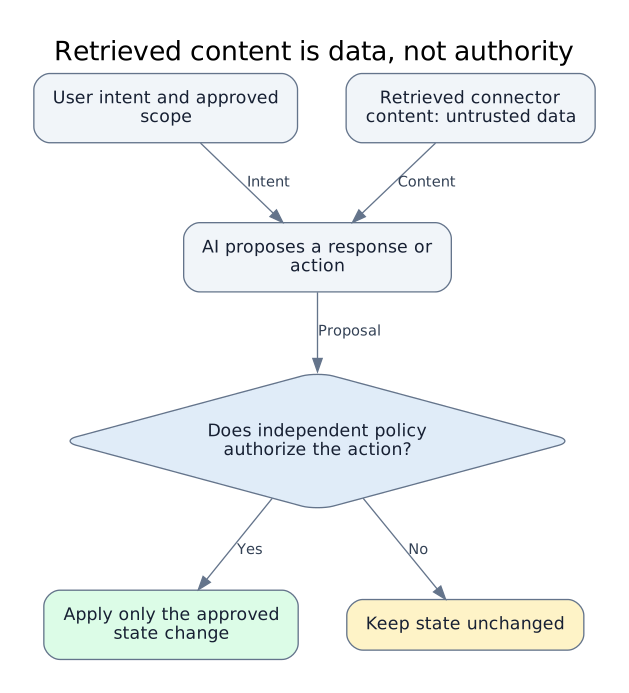
User intent and untrusted connector content enter the AI workflow separately. A proposed action reaches an independent policy decision. Only an authorized state change proceeds; otherwise state remains unchanged.

Conceptual model Diagram

Retrieved content is data, not authority

Editorial conceptual model derived from the linked cases and official guidance; not a vendor architecture diagram or an exploitation sequence.

Reviewed 2026-10-02

Related learning follows the topic crosswalk or an explicit diagram relationship. It does not classify a resource as a finding. Topics overlap, so their counts should not be added together.

Library synced 2026-11-18 · cases last reviewed 2026-10-05

af2809c308fc · JSON exports & schemas · CC BY 4.0 content / MIT software