Root cause
An error-handling configuration could include unintended application data in a response; subsequent review found a broader framework issue.
Demonstrated impact
A copyright-management request could return data fragments not intended for the requester. The award reflected the vendor’s assessment of potential wider impact.
What to check for
- Apply data-minimization rules to error responses as well as successful responses.
- Review shared exception-handling behavior after an endpoint-level fix.
Award and evidence
How the award was verified, and what the record does not establish
Vendor explicitly identifies USD and says the report was paid. Exact transfer date is unknown; this is not the event or program total.
- Historical case; exact award, settlement and deployment dates are unknown.
- The source gives a high-level finding, not a complete technical advisory.
Timeline
- Published
- 2020-02-07explicit · Initial page date; a separate May 7, 2020 update is displayed.
- Reported
- 2019-09inferred · September event in the vendor’s 2019 retrospective; the day is unspecified.
Related visual models
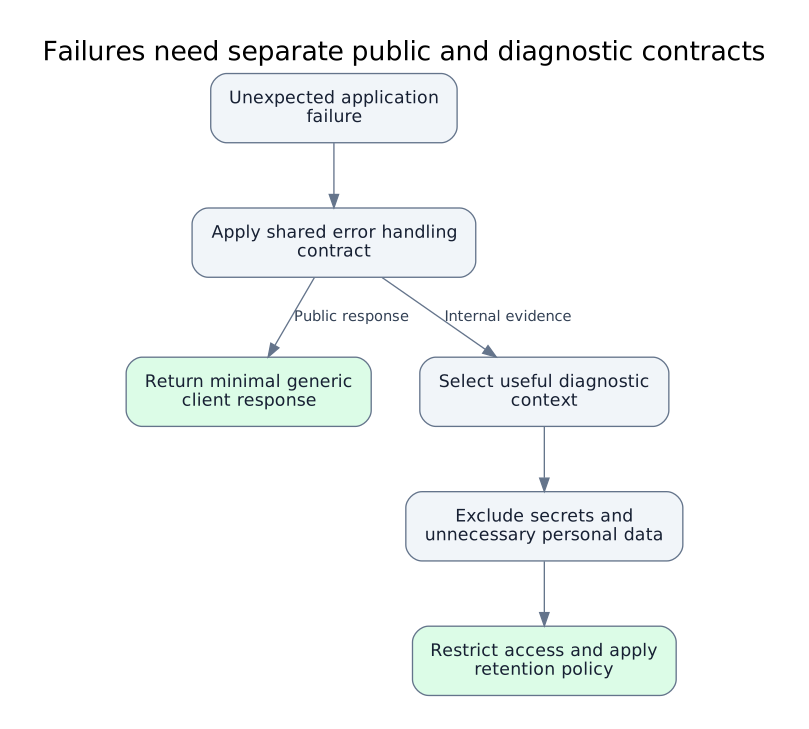
Failures need separate public and diagnostic contracts
Editorial conceptual model derived from the Facebook error-response case and OWASP error-handling and logging guidance. The case establishes unintended response disclosure and broader framework remediation; diagnostic…
Related cases
- Framework serialization change exposed private HackerOne user attributes
HackerOne · Information exposure and response privacy · USD 25,000
- Instagram client configuration exposed an application credential
Meta · Information exposure and response privacy · USD 30,000
- Facebook phone linking lacked account-specific authorization
Meta (Facebook) · Authorization and tenant boundaries · USD 20,000
Sources
- 2019 Bug Bounty highlights, official Spanish editionDan Gurfinkel / Facebook · reviewed 2026-10-02
Record reviewed 2026-10-02. Snapshot af2809c308fc. Open the complete JSON contract.