vulns.co
/
GKData.io MCP and API Buy me a coffee

Vulnerability family

Authentication and identity

Account lifecycle, session integrity, identity-provider trust. 16 disclosures · 50 related references · 5 diagrams.

Disclosures

Related learning

authentik Maintainer Advisory

authentik: source-mapping edits carry identity-rebinding authority

Permission to manage an authentik source connection could also let a user change which local account or group it represented. The CVE-2026-49443 advisory attributes this to identity-mapping fields that the API allowed…

Reviewed 2026-10-03

Amazon Web Services Implementation Guide

AWS IAM security best practices for workload identities

AWS recommends short-lived role credentials for workloads, permissions limited to the actions and resources they need, and removal of unnecessary access. Its guide also covers policy validation, access reviews and…

Reviewed 2026-10-02

Better Auth Maintainer Advisory

Better Auth SCIM: absent ownership must not grant shared authority

Better Auth's maintainer reports that personal SCIM providers without an owner could be managed by unrelated signed-in users. The permission check rejected a mismatched owner only when an owner was recorded. Reported…

Reviewed 2026-10-03

Bugsink Maintainer Advisory

Bugsink: time-unit consistency in account-access token expiry

Bugsink interpreted token lifetimes expressed in seconds as days. Its maintainer reports that unused email-verification, password-reset and new-user setup links therefore stayed valid beyond their intended expiry.

Reviewed 2026-10-03

Google Chrome for Developers Implementation Guide

Chrome bfcache: restored pages and session-state boundaries

A page restored from Chrome's back/forward cache resumes its saved in-memory state rather than loading again from the network. Chrome's guide explains when pages marked no-store may enter that cache, describes eviction…

Reviewed 2026-10-03

GitHub Architecture Guide

GitHub Artifact Attestations: Provenance and Consumer Policy

GitHub's guide explains what signed artifact attestations say about a build, including its workflow, repository, organization, environment, commit, triggering event and OIDC identity information. Consumers use those…

Reviewed 2026-10-12

HotCRP Maintainer Advisory

HotCRP: separate submission visibility from authorship authority

HotCRP allowed permission to view a submission to extend to changing its contact authorship. The maintainer reports that reviewers and program-committee members could gain author-level access to submissions they could…

Reviewed 2026-10-03

Model Context Protocol Technical Standard

MCP elicitation: consent, credential custody and completion

The MCP specification keeps secrets out of form elicitation and places sensitive URL interactions outside the client and model context, with the requesting server and destination visible to the user. Agreeing to open an…

Reviewed 2026-10-04

Model Context Protocol Architecture Guide

MCP scope selection: progressive consent and accumulated authority

MCP's official guidance explains how a server's permission requests influence the permissions a general-purpose client asks the user to grant. Broad discovery metadata and permissions accumulated over time can expand…

Reviewed 2026-10-03

n8n Maintainer Advisory

n8n Dynamic Credentials: authorize credential lifecycle operations

n8n's maintainer advisory reports missing ownership and scope checks in authenticated Dynamic Credentials operations (CVE-2026-54305). The reported effects include unauthorized access to credential metadata, replacement…

Reviewed 2026-10-03

n8n Maintainer Advisory

n8n token exchange: preserve the issuer namespace

n8n's maintainers report that token exchange matched external identities by subject without keeping track of the issuer (CVE-2026-59208). When the feature was enabled with multiple trusted issuers, this could associate…

Reviewed 2026-10-05

n8n Maintainer Advisory

n8n: directory-attribute authority in durable account linking

n8n's maintainer advisory describes account linking that treated a matching LDAP email attribute as proof of account ownership (CVE-2026-33665). It reports that access to the linked account, including administrator…

Reviewed 2026-10-03

Internet Society / NDSS Symposium Research Paper

Cross-device authentication: bind informed consent to session authority

Approving a login from a trusted device does not, by itself, show that the user understands and wants the new session. This research evaluates 27 services and includes a 100-participant user study of missing context,…

Reviewed 2026-10-03

Nhost Maintainer Advisory

Nhost: provider adapters must preserve identity-claim evidence

Nhost's maintainer advisory reports that provider adapters treated an email address or fallback profile attribute as a verified identity claim (CVE-2026-41574). Account linking then accepted that claim as proof of…

Reviewed 2026-10-03

National Institute of Standards and Technology Architecture Guide

NIST SP 800-162: attribute authority and policy traceability

NIST explains how access policies use attributes of the user, resource, requested action and environment to decide whether to allow access. It connects business rules to software-enforced decisions and explains why…

Reviewed 2026-10-03

Obot Maintainer Advisory

Obot: preserve delegated token audience and consent boundaries

Obot's maintainer reports that tokens delegated for MCP were accepted by broader application APIs because checking the issuer did not check the intended recipient (GHSA-xwmw-prc4-v3cr). Client authorization also lacked…

Reviewed 2026-10-03

Open WebUI Maintainer Advisory

Open WebUI: credentials must bind to their destination connection

Open WebUI's maintainer reports unintended session-cookie forwarding in a controlled observation (CVE-2026-87015). Tool functions kept their own headers but read cookies from shared state after connection processing…

Reviewed 2026-10-03

Open WebUI Maintainer Advisory

Open WebUI: revocation must cross HTTP and realtime boundaries

Open WebUI's maintainer advisory describes revoked tokens being rejected over HTTP but accepted for new realtime connections in a local comparison (CVE-2026-59219). Realtime authentication checked the signature and…

Reviewed 2026-10-03

Open WebUI Maintainer Advisory

Open WebUI: preserve role-policy meaning across identity flows

Open WebUI's maintainer reports that token exchange could preserve a user's old role when role evidence was missing (GHSA-2rr4-q6pg-m5g3). Browser sign-in supplied identity-token claims, while token exchange supplied…

Reviewed 2026-10-03

OpenID Foundation Technical Standard

FAPI 2.0 Security Profile

The OpenID Foundation's FAPI 2.0 profile sets coordinated OAuth security requirements for confidential clients, authorization servers and resource servers. It covers sender-constrained tokens and protection of…

Reviewed 2026-10-03

Outline Maintainer Advisory

Outline: integration authority must end with its owning account

Outline's maintainer-published report demonstrates document content still being delivered by a webhook after its administrator creator's account was deleted (GHSA-33jq-x32c-3ccw). Account cleanup left the subscription…

Reviewed 2026-10-03

OWASP Cheat Sheet Series Implementation Guide

OWASP Forgot Password

OWASP explains how to bind recovery challenges to the right account, limit their lifetime and reuse, and control repeated attempts. It also covers consistent responses, user notifications and session handling after a…

Reviewed 2026-10-07

OWASP Cheat Sheet Series Implementation Guide

Authorization Cheat Sheet

OWASP recommends granting only needed permissions, denying access by default and making consistent authorization decisions on every request. The guidance also covers failure handling, logging and regression tests for…

Reviewed 2026-10-02

OWASP Cheat Sheet Series Implementation Guide

HTML5 Security Cheat Sheet: Web Messaging

OWASP explains how to check a browser message's origin and format and handle its contents as data. These are separate controls: verifying the sender does not replace validating the message or handling its content safely.

Reviewed 2026-10-02

OWASP Foundation Training Lab

OWASP Juice Shop: Controlled Web-Security Training

OWASP Juice Shop is a deliberately insecure web application for learning how flaws arise and how to fix them. It offers challenges at different difficulty levels, optional guided tutorials and coding exercises, with…

Reviewed 2026-10-12

OWASP Cheat Sheet Series Implementation Guide

OWASP Session Management: privilege-transition integrity

OWASP explains why applications should issue session identifiers themselves and replace them at login or other privilege changes. Previous identifiers must be retired, and anonymous tracking kept separate from…

Reviewed 2026-10-03

PortSwigger Training Lab

Web Security Academy: Free Online Training from PortSwigger

PortSwigger offers free web-security lessons and purpose-built interactive training environments. Topics include authentication, access control, business logic, API security and other application-security fundamentals.

Reviewed 2026-10-02

Prowler Maintainer Advisory

Prowler SAML: retain validated tenant authority

Prowler's maintainers report that token issuance chose a tenant from an asserted email domain rather than the validated SAML configuration (CVE-2026-59151). They describe possible cross-tenant account takeover. Their…

Reviewed 2026-10-03

Internet Engineering Task Force / RFC Editor Technical Standard

RFC 10017: OAuth 2.0 for Browser-Based Applications

RFC 10017 compares browser-only OAuth clients, token-mediating backends and backend-for-frontend designs by where they keep tokens and manage sessions. It distinguishes protecting token material from limiting what…

Reviewed 2026-10-03

Internet Engineering Task Force / RFC Editor Technical Standard

RFC 9700: Best Current Practice for OAuth 2.0 Security

RFC 9700 updates OAuth security guidance using deployment experience and stronger protocol requirements. It identifies insecure patterns to stop using and provides a primary reference for reviewing identity integrations.

Reviewed 2026-10-06

Saleor maintainers Maintainer Advisory

Saleor email changes: bind confirmation to account and state

Saleor did not check that an email-change confirmation token belonged to the signed-in account. The maintainer's scenario requires a valid token for one account and authenticated access to another; it describes possible…

Reviewed 2026-10-06

samlify Maintainer Advisory

samlify: signing does not establish claim provenance

samlify could turn user-controlled profile text into extra SAML claims before the identity provider signed them. The maintainer's example shows those added attributes being accepted; gaining privileges would also…

Reviewed 2026-10-03

GitHub Security Lab Research Paper

Sentry: resource ownership must match the authorized organization

Sentry checked a user's event-reading permission without ensuring the requested event belonged to that organization. GitHub Security Lab reports cross-organization disclosure in version 25.12.0 by a signed-in user with…

Reviewed 2026-10-03

Sigstore Architecture Guide

Sigstore Security Model

Sigstore's security guide explains how software signatures link an artifact to a signing identity and an auditable history. It describes identity issuers, Fulcio's short-lived certificates, trusted roots and Rekor's…

Reviewed 2026-10-12

Visual models

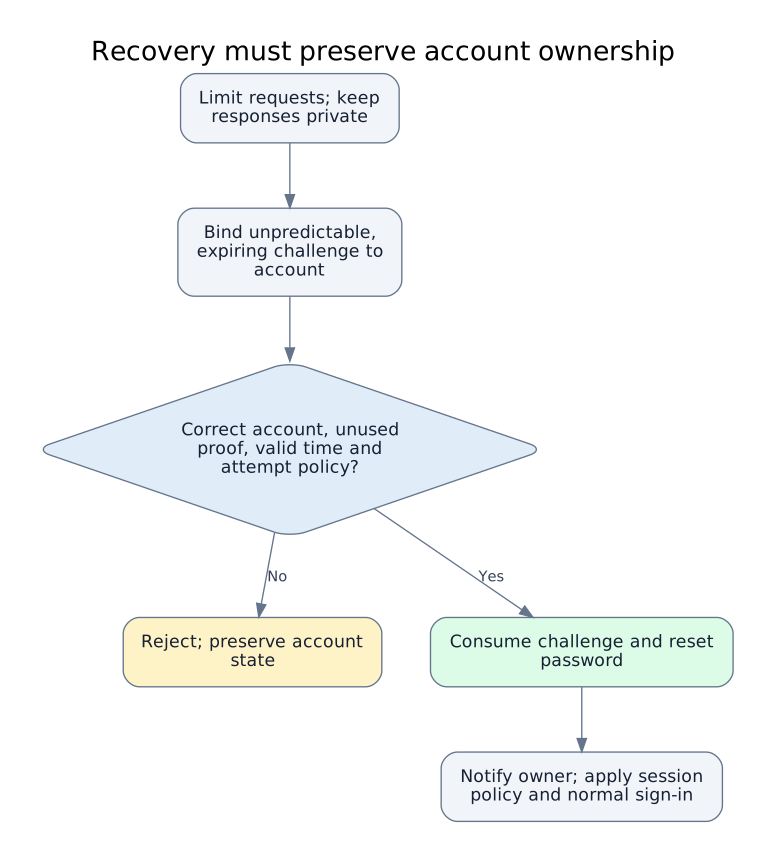
A limited recovery request creates an account-bound challenge. Only valid, unexpired, unused proof permits a reset. Failure preserves account state; success consumes the challenge and notifies the owner.

Conceptual model Diagram

Recovery must preserve account ownership

Editorial conceptual model derived from the linked cases and official guidance; not a vendor architecture diagram or an exploitation sequence.

Reviewed 2026-10-02
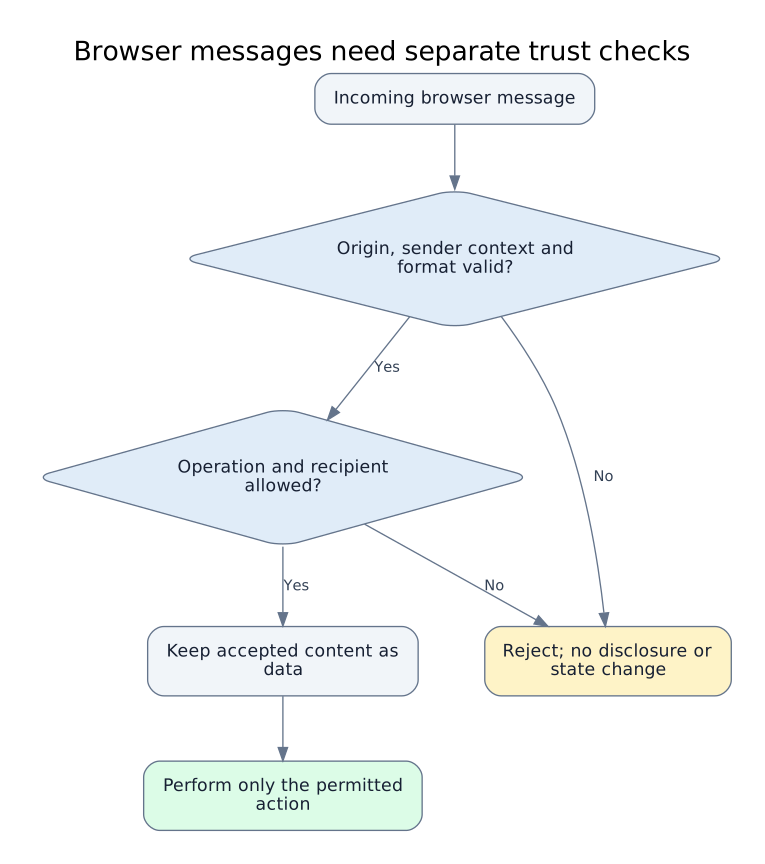
An incoming browser message first passes origin, sender-context and format validation. A separate decision checks the operation and recipient. Failed checks reject the message without disclosure or state change. Approved content remains data and only the permitted action is performed.

Conceptual model Diagram

Browser messages need separate trust checks

Original defensive model combining OWASP messaging and authorization guidance with the linked historical cases. These are independent design checks, not a vendor patch diagram or an operational reproduction.

Reviewed 2026-10-02
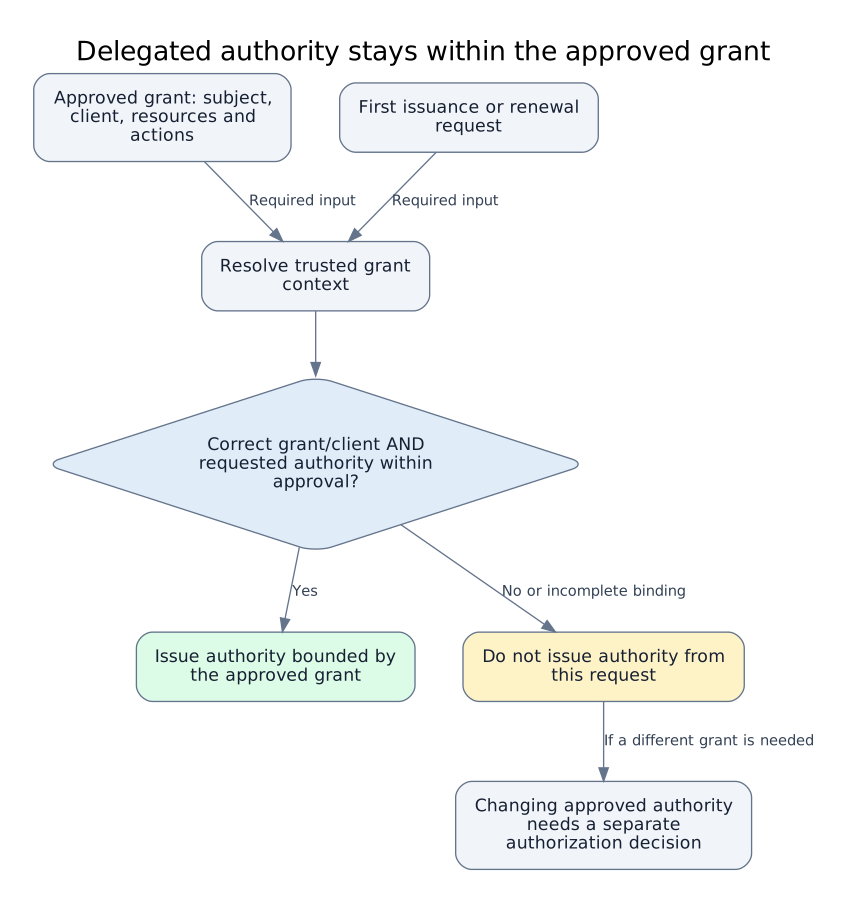
Approved grant context, including subject, client, permitted resources and actions, and a first-issuance or renewal request are both required inputs. Resolve trusted grant context and check that the grant and client are correct and requested authority remains within approval. Issue only bounded authority when all checks pass. Do not issue on mismatch or incomplete binding. Changing the approved authority requires a separate authorization decision; no automatic-consent loop is shown.

Conceptual model Diagram

Delegated authority stays within the approved grant

Original editorial defensive synthesis, not a vendor architecture, protocol sequence or independently verified patch. The Google researcher describes lost client and permission binding through a device grant; proposed…

Reviewed 2026-10-04
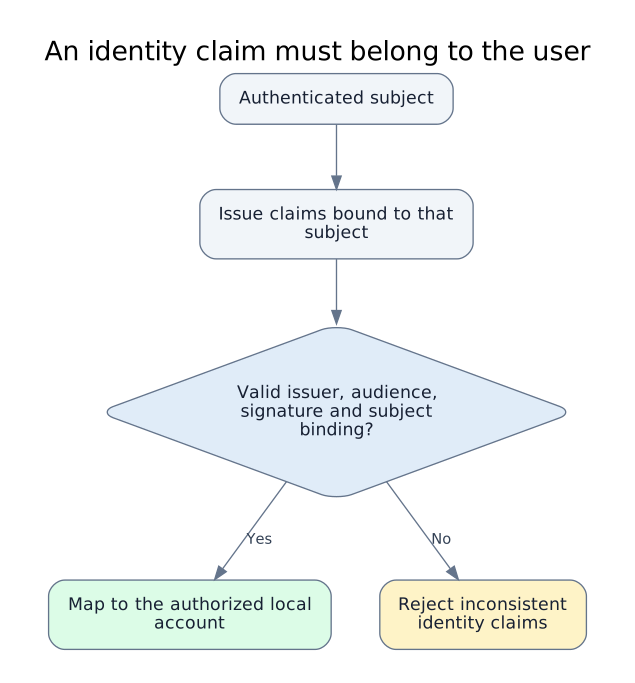
The identity provider authenticates a subject and binds issued claims to it. The relying application validates the issuer, audience, signature, and ownership binding before mapping to a local account. Failed validation is rejected.

Conceptual model Diagram

An identity claim must belong to the user

Editorial conceptual model derived from the linked cases and official guidance; not a vendor architecture diagram or an exploitation sequence.

Reviewed 2026-10-02
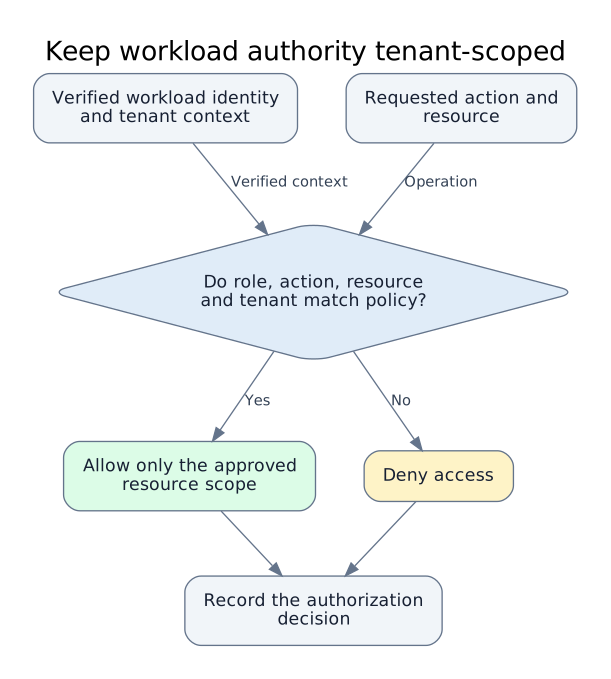
A verified workload identity and a requested operation enter an independent authorization decision. Policy checks the role, action, resource and tenant together. Only the approved resource scope is allowed; other requests are denied. Both decisions produce an audit record.

Conceptual model Diagram

Keep workload authority tenant-scoped

Editorial conceptual model derived from the linked cases and official guidance; not a vendor architecture diagram or an exploitation sequence.

Reviewed 2026-10-02

Related learning follows the topic crosswalk or an explicit diagram relationship. It does not classify a resource as a finding. Topics overlap, so their counts should not be added together.

Library synced 2026-11-18 · cases last reviewed 2026-10-05

af2809c308fc · JSON exports & schemas · CC BY 4.0 content / MIT software