Billing and credits
Review prices, credits, refunds, and entitlements as server-owned state transitions that preserve an auditable ledger invariant.
This is the complete downloadable file. Open plain text ↗
---
name: billing
description: "Review prices, credits, refunds, and entitlements as server-owned state transitions that preserve an auditable ledger invariant."
---

# Billing and credits

Review prices, credits, refunds, and entitlements as server-owned state transitions that preserve an auditable ledger invariant.

Defensive study and review of artifacts supplied by their owner. Record missing evidence as an open question.

## Bring to the review

- Pricing and entitlement rules
- Payment and ledger state model
- Authorized test transactions

## Review guide

### 1. Write the ledger invariant

Define the server-authoritative amount, currency, owner, entitlement, and allowed transition for each business event.

### 2. Bind evidence to transition

Ensure payment confirmations, webhooks, and refunds are authenticated and tied to one intended state change.

### 3. Protect concurrency

Use atomic checks and consumption rules so retries or parallel processing cannot duplicate an entitlement or reversal.

### 4. Reconcile safely

Make correction and recovery flows preserve legitimate concurrent changes and create a complete audit record.

## What to produce

- Ledger invariant
- State-transition map
- Reconciliation and audit criteria

## Common mistakes

- Trusting client totals
- Separating evidence from entitlement creation
- Using non-atomic balance updates

## Reading and source context

### Resources

- [OWASP Transaction Authorization](https://vulns.co/research/resources/owasp-transaction-authorization-state-integrity/)
- [Stripe webhooks: authentic delivery and business-state integrity](https://vulns.co/research/resources/stripe-webhook-delivery-state-integrity/)
- [Paymenter: refund entitlement and ledger changes need one atomic transition](https://vulns.co/research/resources/paymenter-2026-refund-transition-atomicity/)

### Diagrams

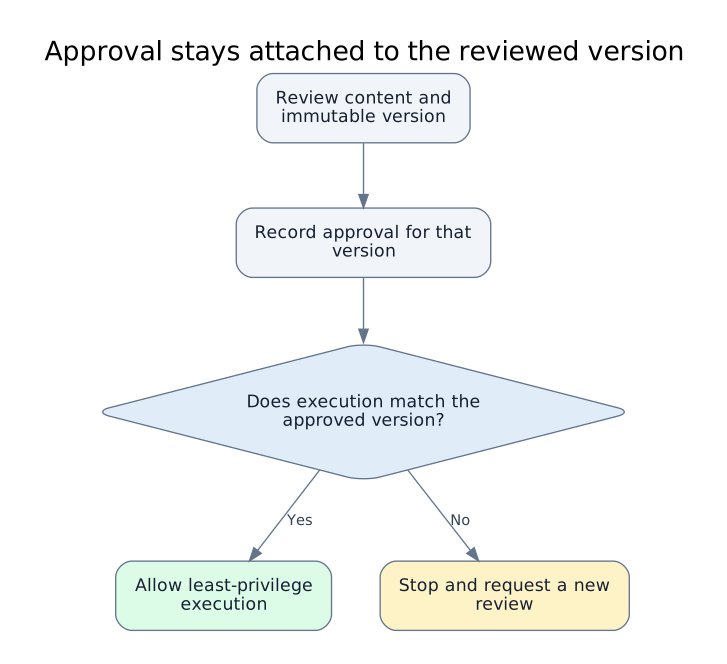
- [Approval stays attached to the reviewed version](https://vulns.co/research/diagrams/approval-version-integrity/)

### Reports

- [Cloud Build approval was not bound to immutable code](https://vulns.co/research/reports/google-cloud-build-approval-toctou-2025/)
- [GitHub Actions trust depended on invalid repository references](https://vulns.co/research/reports/github-actions-reference-validation-2021/)

## Provenance

Editorial guide by vulns.co / GK Data. Updated 2026-10-11.
Library snapshot: 2026-10-04; commit d5550c7891119cf1379e235721541c947850a3b3.
The guide is an editorial synthesis. Linked records preserve their own sources and review dates.

Reader: https://vulns.co/skills/billing/
The review
What to look for
Defensive study and review of artifacts supplied by their owner. Record missing evidence as an open question.
Write the ledger invariant
Define the server-authoritative amount, currency, owner, entitlement, and allowed transition for each business event.
Bind evidence to transition
Ensure payment confirmations, webhooks, and refunds are authenticated and tied to one intended state change.
Protect concurrency
Use atomic checks and consumption rules so retries or parallel processing cannot duplicate an entitlement or reversal.
Reconcile safely
Make correction and recovery flows preserve legitimate concurrent changes and create a complete audit record.
What to produce
- Ledger invariant
- State-transition map
- Reconciliation and audit criteria
Common mistakes
- Trusting client totals
- Separating evidence from entitlement creation
- Using non-atomic balance updates
Continue the study
Reading & source context
Editorial notes above connect these references. Open each record for its original source and review date.
Visual models
Connected disclosures
From the field toolkit
Guide by GK Data · Research snapshot 2026-10-04.
Sources and review dates are preserved in the library provenance.